Wire
Designed to help people with ADHD to relieve their symptoms by daily mind and body activities specific to their symptoms.


Why this project?
I attended a course where I learned about neurodiversity including ADHD. I started doing more research on this condition and encountered a large group of adults who were diagnosed later in life or not formally diagnosed, but discovered on their own - having an aha moment to find the cause of their problem.
Through my project, I wanted to explore more about the journey of adults with ADHD/ADD to find a solution that could help to improve their quality of life.
For the development of wire, I applied double diamond design process of Design Council:
Discover
Define
Develop
Deliver
Discover
Through my secondary research on the realities of ADHD, I found out;
ADHD mainly affects children, but up to 60% of adults with ADHD will continue to show symptoms into their adult life
Undiagnosed ADHD can cause other mental health problems such as anxiety, depression, sleep problems
About 1.5 million adults in the UK have the condition, but only 120,000 are formally diagnosed
After formal diagnosis/self-diagnosis they have a realisation of the reason their struggles and look for a solution

“I could not be successful at school, I always felt bad after finishing the university. I realised I have ADHD thanks to a friend. Now I am more in control.” (ADHD Collective, how does it feel to have ADHD)
Problem Statement
Adults with ADHD have issues throughout their education, work, personal lives and they have hard time to get diagnosis.
Those diagnosed or become aware of the condition often feel relief at knowing the reason for their problems, and certain improvements can happen in their lives.
In order to get deeper insights and understand the pain points, behaviours, and motivations of ADHDers, I conducted user interviews.
I was only able to access people who were officially diagnosed with ADHD. Therefore, research findings have evolved around the realities of living with ADHD.
Biggest challenge of adults with ADHD is to retain focus until the work/task is done
People with ADHD has a constant motivation of learning, exploring and creating things
ADHD is mostly a constant battle where getting diagnosis, treatment is hard and feeling alone with all the struggles
People with ADHD often need an external motivation to move forward - either to receive supportive feedback from others or to help others with their problems.
Define
After my secondary and primary research findings, I came to the conclusion that although the diagnosis is difficult, the main thing is to try to manage the symptoms and adapt to the neurotypical life. So I framed my HMW question around that.
How might we help adults with ADHD to manage their symptoms so that their quality of life would improve?

“I got distracted by little things, I skip task to task without finishing”
Meet David
David is a freelance designer based in London. He is single.
He has several interests and hobbies, but can't sustain many of them.
His main goal is to be able to finish one of his projects. Learning and trying new things is his biggest motivation.
He has taken therapy sessions and considered medication, but he does not believe the medication will be sustainable due to its side effects.
He is always looking for other solutions, including digital solutions, to help him relieve his symptoms and lead a more fulfilling life.
Pain points
-
Gets distracted easily while doing a task at work
-
Has struggles to start a work, sustain the focus-motivation and finish it on time
-
Tries different ways to solve his problems, but they do not tend to be sustainable
-
Has considered medication, but he thinks it can very sticky and not explored well
Motivations
-
Tries to stick to a morning routine like walking, exercising everyday
-
Works hard for self improvement; reading books, watching videos, following blogs about his condition
-
Uses Instagram, Youtube, Whatsapp, Netflix frequently. Favorite platform is Youtube where he can learn and "productively procrastinate"
-
Sometimes gets support from organisational apps like Motion, Pomodoro, Forest, but they do not help long term
Goals & Needs
-
Feeling mentally and physically balanced
-
Constant motivation, and enforced routine
-
Things that can help to increase dopamine, adrenalin
-
Needs a solution that can integrate in his life, gives a reason to come back, remains fun with new challenges
I developed my user stories and created epics. I selected to work on the epic of "following a daily plan" with the following user stories:
-
As an ADHDer I want to be able to find exercises that can help my symptoms so that I can have a better performance at work/school
-
As an ADHDer I want to follow a daily, regular plan, so that I can see long term effects
Then, regarding the epic I chose, I created my task flow starting from the landing page, selecting symptoms, starting and completing an activity, and finishing with progress

People with ADHD suffer from lack of concentration, memory, procrastination, etc. and time to time they try organisational or self-helps apps to alleviate their struggles. However, although these app are beneficial for a while, they cannot be long-term for them.
That's why they are constantly looking for the best solution that will fit to their life. While some of the struggles of people with ADHD are similar to those of neurotypical people, I believe ADHDers experience them differently and there is an opportunity for a solution tailored to their needs.

Develop
Idea of the app
Regarding my HMW question, I explored ways to help adults with ADHD manage their symptoms and improve their quality of life. Through my research, I've discovered that neuroplasticity can help people with ADHD manage their symptoms.
Neuroplasticity is the brain's ability to rewire itself by forming new neural connections throughout life. It can be achieved through regular and structured mind training that can teach the brain to better manage its own brain-wave activity, leading to reduction of the symptoms.

So I decided to design a mobile application where users can find mind and body exercises in line with their symptoms.
I didn't get a chance to discuss the exercises with neurology or psychology experts.
I tried to take inspiration from other mind exercise apps to develop the.
Sketching of the idea


Lo - Fidelity Wireframes
I have built my wireframes with a flow of onboarding, selecting symptoms, daily exercise plans and progress screens


Usability Tests
Two rounds of user testing
10 people in total
Major Issues:
-
User expected to see more information about the app on onboarding
-
User did not feel clear about what happens after selecting one focus only
-
User confused about which one to choose from the exercises, facts and tips
-
User could not match feeling check-in question with the app
-
User got confused how the badges work, how to gain them and the connection between days and badges
-
User wanted to see the progress on the program
Validations:
-
User liked the idea of having daily program changing
-
User liked playing a game for training
After analysing the major issues, I created a Prioritisation Matrix to decide which ones to work on and selected these issues:
Simplify the onboarding with 3 steps; information about the app, select focus and start
Add the exercise options on the homepage without any need to go another page
Create a better game/exercise experience
Find other ways to show progress and achievements
Simplify the onboarding with 3 steps; information about the app, select focus and start
Add the exercise options on the homepage without any need to go another page
Create a better game/exercise experience
Find other ways to show progress and achievements
Mid - Fidelity Wireframes
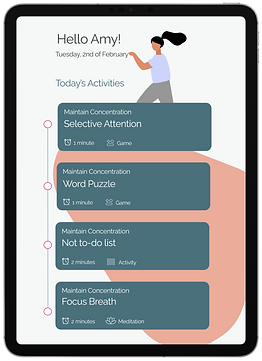
I applied the revisions on my lo-fi wireframes in regards to the usability testing outcomes
-
I intended to create a simplified and clearer onboarding process
-
I added some games and activities to give a better idea about the experience
-
On homepage I created a different section for the tips and facts buttons, made a list for the daily activities to show them directly without going to another page
-
I redesigned the progress section with more detailed information, taken out the badges from the flow since it was confusing at this stage


Brand Development
Naming
In order to find the name of my app, I wrote down the concepts inline with neuroplasticity and tried to create some associations between them.
You will train your brain and with an active mind you will build new neural connections which is rewiring the brain

Name alternatives:
Rewire: can be bold at this stage, feels like it promises something
Wire: I feel it is another way of saying connect and it has a reference to brain wires. It does not have a meaning solely, but with an icon complementing it can work and I decided to move with this name

Inspiration - curated photos
Keywords:
dynamic, relaxing, modern, effective, connected

Colors
With the curated photos from my inspiration board, I created my color palette with primary and accent colors

Typography
For the typographic inspiration I looked for a font that can give dynamic, modern and relaxing feeling while using the app. Comparing similar options I liked Raleway most due to its more rounded and soft shape.

Wordmark creation
I tried to base my wordmark inline with the naming and the main idea of “neural connections”, “bonding".
After looking for some inspiration, on step 1 I created shapes connected to each other, played around with different versions. However, I needed something that can represent the neurological side of the app as well and I ended up designing two shapes that resemble brain lobes and one shape that bonding them together.

Logo


Deliver


Marketing Website
I designed a marketing website to introduce and promote the app.
I used big and bold marketing message and screens from the app on the hero section.
I created an experience section showing what kind of experience is expecting them on the app by icons and explanations. And a features section help users to picture what they would find in the app as well as pricing and testimonials.
.png)
.png)
.png)
Design Impact
Most of the apps contain too much modules or content making them hard to follow after some time for ADHDers
-
I believe my design might help adults with ADHD to stick to a routine better with engaging, simple activities
-
Not pushing to be multitasking and having one focused plan at a time can facilitate to follow
-
Since the activities are changing daily, it may create more excitement, less bored even spending long time
I stretched my thinking with tarot card with tech, I selected The Service Dog card.
In regards to the question, even though I have a specific target I think this app can help other target groups as well. For instance, a recent study says the human attention span has dropped to eight seconds – shrinking nearly 25% in just a few years. (Microsoft, 2021) People can improve their concentration skills through the activities in the app.
Another option can be creating a plan specific to children with ADHD with games and activities they like.

Key Learnings
-
It is crucial to spend good time on sketching and inspiration before starting to design the experience, it facilitates everything.
-
Time constraints were the main issue throughout the process; researching, designing, presenting - all brought their own challenges within the limited time. I am happy I could manage all. I believe it is all about thinking simple and give the time to yourself.
-
It was challenging to decide the games and activities that can best represent the idea without consulting to ADHD experts.
-
Besides, I believe game design needs a different type of expertise as well - like knowing all kinds of animations, creating illustrations, and deciding all the elements of the games.
Next Steps
-
Have further research and consultation from ADHD experts to design the activities
-
Test the overall experience with ADHDers
-
Add test and guide for self-diagnosis